The History
FOLLOWING IN THE FOOTSTEPS OF THE FAIRYTALE KING SINCE 1968
What began in 1967 with an idea in an Oberammergau inn developed into one of Europe’s most traditional ski marathon events and Germany’s largest mass-participation cross-country ski race.
The König Ludwig Lauf is far more than a ski race. For decades, it has combined sporting challenge with a unique natural and cultural landscape, international cross-country skiing history with Bavarian hospitality, and elite sport with recreational competition. Its course runs through a landscape that remains inseparably linked to King Ludwig II to this day: from Ettal into the Graswang Valley, past Linderhof Palace and back towards Oberammergau.
For more than half a century, thousands of athletes, volunteers, clubs and people from the region have worked together to write a story that began in 1968.
1967: AN IDEA IS BORN
The story begins one year before the first race.
In 1967, Fritz Lang and Benedikt Stückl developed the idea for a major cross-country ski race in Oberammergau. Their ambition was remarkable: the new race was to be longer than Sweden’s already world-famous Vasaloppet.
At the time, the Vasaloppet covered 89 kilometres.
So Oberammergau planned a distance of 90 kilometres.
The original name was:
“Bavarian Cross-Country Ski Race – In the Footsteps of King Ludwig”
The name said it all. The course led through a landscape closely associated with King Ludwig II, parts of which had once belonged to him.
What began as an idea in Oberammergau was therefore an exceptionally ambitious project from the very start.
17 MARCH 1968: THE FIRST KÖNIG LUDWIG LAUF
On 17 March 1968, the time had finally come.
The ski division of TSV Oberammergau organised the first race. Two distances were offered: 45 and 90 kilometres. The long-distance race consisted of two laps.
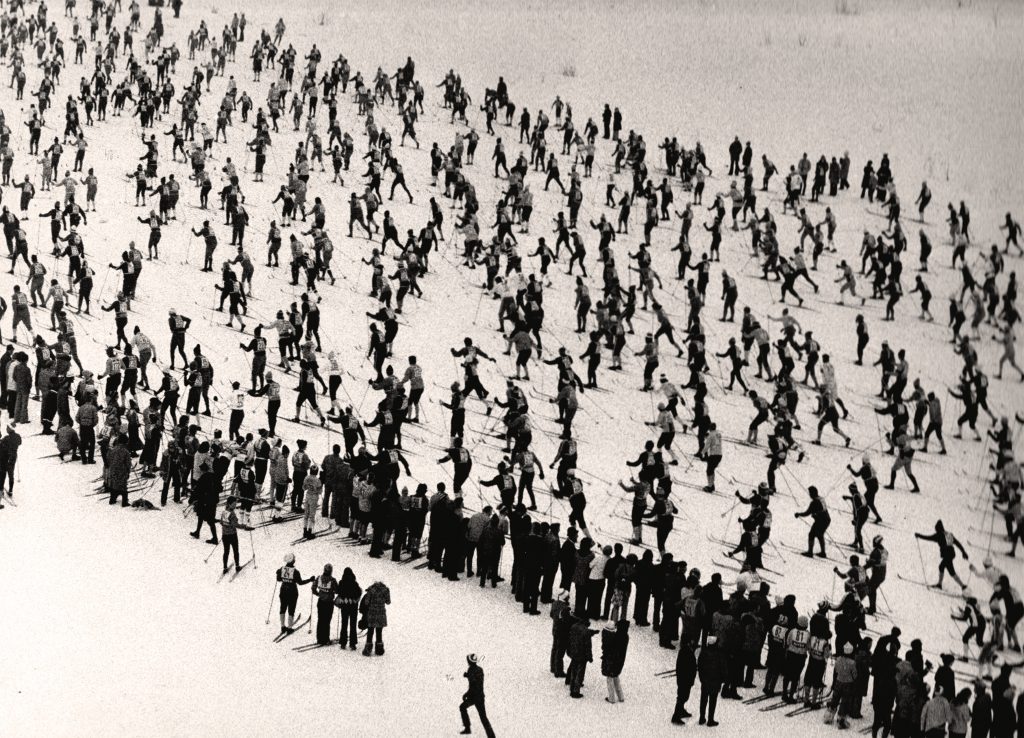
The start was located at the sports ground in Ettal, while the finish was at the area known as Frauenwasserl in the Ettal Weidmoos. According to reports, almost two metres of snow lay on the ground at the time.
796 participants lined up for the inaugural race.
For a completely new cross-country skiing event, this was already an impressive number.
Forestry Director Alfred Artmann played an important role in organising the event and designing the course. At the time, women were not yet permitted to compete over the long distance – something that would not change until several years later.
Klaus Niedermeier became the first winner of the long-distance race.
The foundations had been laid.
FROM AN OBERAMMERGAU MASS-PARTICIPATION RACE TO AN INTERNATIONAL SKI MARATHON
Growth began almost immediately.
In 1969, 871 participants took part. In 1970, the race exceeded the 1,000-participant mark for the first time, with 1,130 athletes. Just three years after the inaugural event, 1,383 cross-country skiers were already on the start line in 1971. That year also saw the first Norwegian take part in the König Ludwig Lauf.
The first participants from Italy arrived in 1973.
By then at the latest, what had started as a Bavarian event was increasingly becoming an international ski marathon.
In 1974, more than 2,000 skiers were already on the start line, including over 300 participants from abroad. During this period, the König Ludwig Lauf joined the Dolomitenlauf in Austria and Marcialonga in Italy as part of the Alpentris.
This marked the beginning of international cooperation between Europe’s major ski marathons.
PAULI SIITONEN AND THE GREAT NAMES OF CROSS-COUNTRY SKIING
As its international significance grew, some of the finest long-distance skiers of their era also came to Oberammergau.
One athlete in particular left his mark on the history of the König Ludwig Lauf:
Pauli Siitonen.
The Finn won the König Ludwig Lauf six times during the 1970s and early 1980s. Siitonen is also regarded as one of the pioneers of today’s skating technique. The “Siitonen step”, named after him, was a forerunner of modern skating.
Decades later, Czech skier Stanislav Řezáč equalled Siitonen’s record with six victories of his own.
Numerous other elite international athletes from Scandinavia, Central Europe and beyond have made the König Ludwig Lauf a regular meeting point for the international ski marathon community over the decades.
1976: THE RACE FINDS ITS HOME IN FEBRUARY
The first editions of the race had still been held in March.
In 1976, the König Ludwig Lauf moved to February for the first time – the time of year with which it remains associated today.
At the same time, an impressive course was created: from Ettal via Linderhof and Graswang to Oberammergau, continuing through Unterammergau, Altenau and Unternogg to Wildsteig and back again.
90 kilometres through the Ammertal Valley and the Ammergau Alps.
More than 2,100 participants took part.
In 1977, the König Ludwig Lauf was held as a two-day event for the first time. Alongside the long-distance races, shorter family events were introduced. A philosophy that still defines the event today was already beginning to emerge: world-class sport and ambitious ski marathon racing on the one hand, recreational sport and youth development on the other.
In the same year, the König Ludwig Lauf became an independent division within TSV Oberammergau.
1978: FOUNDING MEMBER OF THE WORLDLOPPET FAMILY
In 1978, a milestone was reached whose significance continues to this day.
The König Ludwig Lauf became one of the founding members of the Worldloppet Ski Federation.
Worldloppet brings together the leading ski marathon events from different countries. Since the federation was founded, the König Ludwig Lauf has represented Germany within this international association.
Oberammergau was now firmly established alongside legendary races such as the Vasaloppet, Marcialonga, Engadin Skimarathon, American Birkebeiner and Birkebeinerrennet.
By 1979, athletes from 23 nations were travelling to Oberammergau. A ceremony was held in front of the Passion Theatre to welcome the international guests, accompanied by a torchlight procession through the village.
The König Ludwig Lauf had long since become more than a regional sporting event.
It had become international.
1980: WOMEN TAKE ON THE 90 KILOMETRES
An important new chapter began in 1980.
For the first time, women were allowed to compete over the 90-kilometre distance.
At the same time, another milestone was reached:
More than 3,000 participants came to Oberammergau and Ettal.
Around 3,300 participants followed in 1981, and approximately 3,450 in 1982.
In 1983, the race reached a historic peak for this era with around 3,700 participants.
A small event that had begun just 15 years earlier with 796 participants had now firmly established itself among the major international ski marathons.
SNOW, WEATHER AND THE ART OF IMPROVISATION
The history of the König Ludwig Lauf is not only a story of great sporting moments.
It is also a story of the weather.
As early as 1972, the event had to be cancelled for the first time due to a lack of snow. Further cancellations and course changes followed.
In 1977, the 90-kilometre race was shortened to 73 kilometres.
In 1983, snow conditions meant that only 70 kilometres were possible. In 1984, the organisers finally said goodbye to the original 90-kilometre distance and reduced the main race to 65 kilometres.
Following a series of difficult winters, a long-distance course of approximately 50 kilometres eventually became established.
This history reveals something that remains part of the König Ludwig Lauf to this day: adapting, improvising and doing everything possible to give the athletes a race.
In 1986, for example, a strong Foehn wind severely damaged the trails immediately before the event. Volunteers from Oberammergau and neighbouring communities worked around the clock together with the German Armed Forces. Ultimately, a 25-kilometre loop could be prepared and was raced twice.
In 1989, more than 3,000 cubic metres of stored snow were moved in order to stage the event despite difficult conditions.
THE KÖNIG LUDWIG LAUF AND ITS REGION
Stories like these explain why the König Ludwig Lauf would be unthinkable without its home region.
Since 1968, the event has been supported by people from Oberammergau, Ettal, Graswang and the surrounding communities.
Fire brigades, mountain rescue services, the Bavarian Red Cross, sports clubs, local authorities, landowners, forestry services, public agencies, institutions and many other organisations all work together.
Today, around 400 volunteers are involved in staging the event.
They prepare the courses, secure road crossings, operate refreshment stations, organise the start and finish areas, look after participants and help wherever assistance is needed.
This community spirit is an essential part of the DNA of the König Ludwig Lauf.
A professional sporting event and a warm, family atmosphere are not contradictions here.
THE 1990s: NEW INTERNATIONAL REACH AND NEW EVENTS
Following several difficult winters with little snow, another phase of development began during the 1990s.
For a time, Oberammergau even hosted the General Secretariat of the Worldloppet organisation, giving it an important organisational role within the international ski marathon family.
In 1995, two formats were added that would accompany the König Ludwig Lauf for many years.
For the first time, the event hosted a World Cross-Country Skiing Championship for Doctors and Pharmacists.
At the same time, the Mini-Kini was introduced as a dedicated event for children. By the year 2000, more than 200 children were already taking part.
The König Ludwig Lauf now covered an even broader spectrum: international elite athletes, ambitious recreational skiers, doctors and pharmacists, and the next generation of cross-country skiers all shared centre stage during one event weekend.
1997: FROM A TSV DIVISION TO KÖNIG LUDWIG LAUF E.V.
The organisational structure of the event continued to evolve as well.
Since 1977, the König Ludwig Lauf had existed as an independent division of TSV Oberammergau.
On 4 July 1997, it became an independent association officially entered in the register of associations.
The König Ludwig Lauf e.V. assumed responsibility for organising the event from that point onwards.
A movement that had grown over several decades had now found the organisational home it retains to this day.
FROM A MASS-PARTICIPATION RACE TO INTERNATIONAL ELITE COMPETITION
Around the turn of the millennium, international ski marathon racing became increasingly professional.
In 2000, the FIS established its Cross-Country Skiing Marathon Cup. The König Ludwig Lauf became part of this development, strengthening its combination of recreational sport and international elite competition.
Over the following years, some of the world’s best ski marathon athletes lined up at the start in Ettal.
Particularly influential was Czech skier Stanislav Řezáč, who won the classic long-distance event at the König Ludwig Lauf six times between 2000 and 2012.
Yet the race always remained what it had been since 1968: an event where, just a few metres behind the international elite, recreational and amateur athletes from all over the world set out on exactly the same course.
2011: THE KÖNIG LUDWIG LAUF BECOMES A LIVE EVENT
In 2011, the event’s media presence reached a new level.
For the first time, the main classic race was broadcast live on television and online.
From 2011 to 2016, the König Ludwig Lauf was also part of the international Ski Classics series.
This brought the race even greater exposure within professional ski marathon racing and to an international audience.
At the same time, 2014 once again demonstrated the event’s extraordinary organisational strength. Due to difficult snow conditions, the planned finish in Oberammergau could not be used. Both the start and finish were relocated to Ettal, and the long-distance race was held over two laps.
Despite this, around 4,200 participants took part.
2018: KÖNIG LUDWIG WITHOUT SKIS
Fifty years after the first ski marathon, a new chapter was added to the story.
In 2018, the König Ludwig Trail was held for the first time.
Runners could now experience the landscape between Ettal and Oberammergau without skis.
This increasingly opened up the König Ludwig Lauf brand to year-round sport. The trail event subsequently evolved into today’s summer tradition.
Today’s König Ludwig Lauf Summer Edition continues this concept with a half marathon, Panoramic Run, Wellness Run and Kids Trail.
Whether in winter or summer, both events share the same idea: physical activity in an extraordinary natural and cultural landscape.
2019: A WORLD RECORD ON THE HOME STRAIGHT
In 2019, the König Ludwig Lauf produced an extraordinary sporting moment.
The König Ludwig SuperSprint, a 100-metre race, was held for the first time.
Italian roller-ski world champion Emanuele Becchis covered the distance on cross-country skis in just 10.78 seconds.
A world record.
Alongside its ski marathon tradition, the König Ludwig Lauf had now also written its name into cross-country skiing history over the shortest possible distance.
THE CHALLENGES OF A NEW ERA
The years that followed demonstrated more clearly than ever the challenges facing winter sports events.
In 2020, the König Ludwig Lauf had to be cancelled due to a lack of snow.
In 2021, the COVID-19 pandemic prevented the event from being held as planned.
The König Ludwig Lauf returned in 2022, before another series of difficult winters followed.
In both 2024 and 2025, weather conditions again prevented the event from taking place as planned. In 2025, warm temperatures, storms and heavy rain damaged the trails so severely that staging the event was no longer considered responsible.
But giving up has never been part of the history of this race.
A NEW STRATEGY FOR THE FUTURE
The experiences of recent years led to a fundamental new approach.
Instead of relying exclusively on one long, continuous course, the organisers developed a scalable course concept. At its heart is a core loop that can be prepared as reliably as possible and extended according to the prevailing snow conditions.
The principle is:
From a secure core to the maximum possible course.
In this way, the König Ludwig Lauf combines its traditions with the demands of a changing climate.
The strategy is supported by organisations including the German Ski Association, the municipalities of Oberammergau and Ettal, and the Ammergau Alps region.
2026: THE KÖNIG LUDWIG LAUF IS BACK
Following two consecutive weather-related cancellations, the König Ludwig Lauf made its comeback in 2026.
On the final day of January and the first day of February, athletes returned to the trails between Ettal, Graswang and Oberammergau.
Around 1,300 cross-country skiers took part in the freestyle events on Saturday alone. Even more participants followed in the classic technique races on Sunday.
In almost ideal winter conditions, the international Worldloppet family celebrated the return of Germany’s traditional ski marathon.
At the same time, the German Ski Marathon Championships were once again held as part of the König Ludwig Lauf.
After several difficult years, this weekend was more than just another edition of the race.
It was a new beginning.
TRADITION MEANS CONTINUING TO EVOLVE
From 796 participants in 1968 to an internationally renowned ski marathon.
From 90 kilometres on wooden skis to classic and freestyle competitions over a variety of distances.
From a men-only race to an event for women and men, children, recreational athletes and international elite competitors.
From the Bavarian Cross-Country Ski Race “In the Footsteps of King Ludwig” to a founding member of the Worldloppet family.
From a purely winter event to the König Ludwig Lauf Summer Edition.
And from a 90-kilometre course to a flexible, future-ready course system.
The history of the König Ludwig Lauf shows that tradition does not mean standing still.
Tradition means knowing your roots while having the courage to reinvent yourself time and again.
MORE THAN A RACE
Throughout all these decades, something has remained that can hardly be expressed in kilometres, finishing times or participant numbers.
The special atmosphere.
The early morning at the start area in Ettal. The basilica in the background. Thousands of skis in the snow. The first view into the Graswang Valley. The passage through the landscape of King Ludwig II. The route towards Linderhof. The volunteers along the course. Spectators, cowbells and cheers. And finally, the finish.
Here, Olympic athletes meet recreational skiers, Worldloppet Masters meet people taking on their first ski marathon, and athletes from more than 30 nations meet a region that has worked together for decades to make its race possible.
Perhaps that is precisely the secret of the König Ludwig Lauf.
It does not belong only to the winners.
It belongs to everyone who races it, organises it, supports it and carries its story forward.
Since 1968.
In the Footsteps of King Ludwig.
In the Heart of the Ammergau Alps.